Episode Notes
Rationale behind combination
Target different points along same pathway
PI3K Pathway
Or RTK/RAS/CTNNB1 pathway altered in 80-90% of low-grade endometrioid tumors
Interacts with androgen/estrogen signaling pathway
PI3K inhibitors (i.e. alpelisib) only work with concomitant hormonal inhibition
GOG 3069: phase 2 study of alpelisib + fulvestrant for PIK3CA-mutated ER-positive endometrioid endometrial cancer
mTOR Inhibitors
Downstream from PI3K
Endometrial cancer: everolimus + letrozole
But only agent that can be used as monotherapy (still less effective though)
Albumin-bound sirolimus: preferred systemic option for locally-advanced unresectable or metastatic malignant PEComa
TSC2 mutation strongly predicts benefit
AKT Inhibitors
Capivasertib: only FDA-approved
Approved in combination with fulvestrant for HR-positive, HER2-negative advanced/metastatic breast cancer with a PIK3A/AKT1/PTEN alteration
Approved in combination with abiraterone and prednisone for PTEN-deficient metastatic prostate cancer
CDK4/6 Inhibitors
Combined with anti-estrogen
Cyclin D - CDK4/6 - Rb axis drives the cell cycle
Cyclin D1
Direct transcriptional target of estrogen receptor
Green et al.
Phase 2 study of fulvestrant + abemaciclib in HR-positive advanced or recurrent endometrial cancer
ORR 44% vs 3-14% seen with SERD monotherapy
91% of responses occurred in copy-number-low, NSMP tumors
Zero benefit in p53 mutated tumors
GOG 3025, Slomovitz et al.
Phase 2 study of letrozole + ribociclib in LGSOC
ORR 31%, clinical benefit rate 84%, median duration of response 21.2 months
Resistance Mechanisms
ESR1 mutation
Makes estrogen pathway constitutively active (on without estrogen binding)
Can use SERD to degrade the receptor
Fulvestrant better than exemestane in ESR1-mutant breast disease
Imlunestrant
Newer oral SERD
FDA-approved in ESR1-mutateed breast cancer
Being investigated in endometrioid endometrial cancer in phase ½ EMBER trial
ORR 18% when combined with abemaciclib
Elacestrant
FDA-approved in ESR1-mutated breast cancer
Under investigation w/ or w/o abemaciclib in endometrial cancer
Toxicities
Generally favorable compared to cytotoxics
CDK4/6
Neutropenia: G3+
22% abemaciclib + fulvestrant
47% ribociclib + letrozole
44% palbociclib + letrozole
mTOR
Everolimus + letrozole
Most common AEs: anemia, mucositis, hyperglycemia, fatigue, pneumonitis
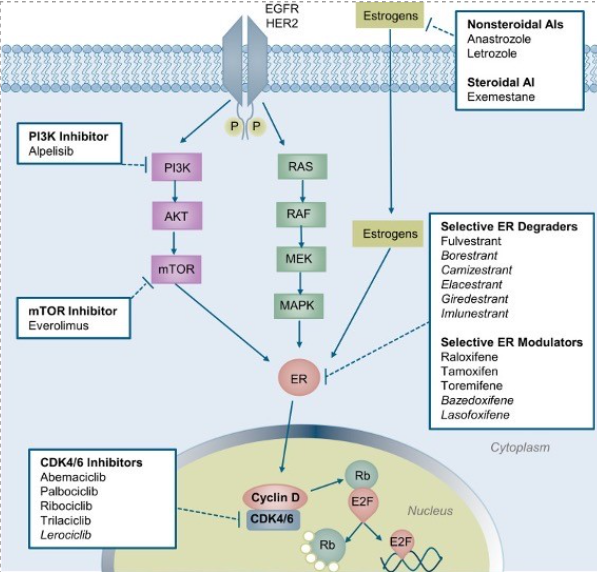
Image: from Ray-Coquard et al 2023
Figure 1 Combining endocrine and targeted therapies to overcome resistance. Resistance to endocrine therapies is common in hormone-driven cancers. Current strategies to overcome this resistance are focused on inhibiting upstream signaling pathways and CDK4/6. Approved therapies, and those currently in clinical development (italicized), are depicted with mechanisms of action that include targeting estrogens, estrogen receptor (ER), growth signaling pathways, and CDK4/6.
Bibliography
1. Gaillard S, Sill M, Klein J, et al. GOG3069: Phase 2 study of alpelisib and fulvestrant for PIK3CA-mutated estrogen receptor (ER)-positive endometrioid endometrial cancers. Journal of Clinical Oncology. 2024;42(16_suppl):TPS5639-TPS5639. doi:10.1200/JCO.2024.42.16_SUPPL.TPS5639
2. Gershenson DM, Bodurka DC, Coleman RL, Lu KH, Malpica A, Sun CC. JOURNAL OF CLINICAL ONCOLOGY Hormonal Maintenance Therapy for Women With Low-Grade Serous Cancer of the Ovary or Peritoneum. J Clin Oncol. 2017;35:1103-1111. doi:10.1200/JCO.2016.71.0632
3. Ray-Coquard I, Monk BJ, Lorusso D, et al. The promise of combining CDK4/6 inhibition with hormonal therapy in the first-line treatment setting for metastatic or recurrent endometrial adenocarcinoma. International Journal of Gynecological Cancer. 2023;33(12):1943. doi:10.1136/IJGC-2023-004739
4. Turner NC, Oliveira M, Howell SJ, et al. Capivasertib in Hormone Receptor–Positive Advanced Breast Cancer. New England Journal of Medicine. 2023;388(22):2058-2070. doi:10.1056/NEJMOA2214131
5. Green AK, Zhou Q, Iasonos A, et al. A Phase II Study of Fulvestrant plus Abemaciclib in Hormone Receptor-Positive Advanced or Recurrent Endometrial Cancer. Clin Cancer Res. 2025;31(11):2088-2096. doi:10.1158/1078-0432.CCR-24-1999
6. Slomovitz BM, Filiaci VL, Coleman RL, et al. GOG 3007, a randomized phase II (RP2) trial of everolimus and letrozole (EL) or hormonal therapy (medroxyprogesterone acetate/tamoxifen, PT) in women with advanced, persistent or recurrent endometrial carcinoma (EC): A GOG Foundation study. Gynecol Oncol. 2018;149:2. doi:10.1016/j.ygyno.2018.04.012
7. Slomovitz B, Deng W, Killion J, et al. GOG 3026 A phase II trial of letrozole + ribociclib in women with recurrent low-grade serous carcinoma of the ovary, fallopian tube or peritoneum: A GOG foundation study (001). Gynecol Oncol. 2023;176:S2. doi:10.1016/j.ygyno.2023.06.466
8. Yonemori K, Boni V, Min KG, et al. Imlunestrant, an oral selective estrogen receptor degrader, as monotherapy and combined with abemaciclib, in recurrent/advanced ER-positive endometrioid endometrial cancer: Results from the phase 1a/1b EMBER study. Gynecol Oncol. 2024;191:172-181. doi:10.1016/j.ygyno.2024.10.006
9. Study Details | NCT07209449 | A Study of Elacestrant Alone or in Combination With Abemaciclib in People With Endometrial Cancer | ClinicalTrials.gov. Accessed October 10, 2026. https://clinicaltrials.gov/study/NCT07209449
10. FDA approves elacestrant for ER-positive, HER2-negative, ESR1-mutated advanced or metastatic breast cancer | FDA. Accessed October 10, 2026. https://www.fda.gov/drugs/resources-information-approved-drugs/fda-approves-elacestrant-er-positive-her2-negative-esr1-mutated-advanced-or-metastatic-breast-cancer
11. Konstantinopoulos PA, Lee EK, Xiong N, et al. A Phase II, Two-Stage Study of Letrozole and Abemaciclib in Estrogen Receptor-Positive Recurrent Endometrial Cancer. J Clin Oncol. 2022;41:599-608. doi:10.1200/JCO.22
12. Pedroza DA, Subramani R, Lakshmanaswamy R. Classical and Non-Classical Progesterone Signaling in Breast Cancers. Cancers 2020, Vol 12, Page 2440. 2020;12(9):2440. doi:10.3390/CANCERS12092440
13. Yang S, Thiel KW, Leslie KK. Progesterone: the ultimate endometrial tumor suppressor. Trends Endocrinol Metab. 2011;22(4):145. doi:10.1016/J.TEM.2011.01.005
14. Mirza MR, Bjørge L, Marmé F, et al. Palbociclib plus letrozole in estrogen receptor-positive advanced/recurrent endometrial cancer: Double-blind placebo-controlled randomized phase II ENGOT-EN3/PALEO trial. Gynecol Oncol. 2025;192:128-136. doi:10.1016/j.ygyno.2024.12.003
15. Fiorica J V., Brunetto VL, Hanjani P, Lentz SS, Mannel R, Andersen W. Phase II trial of alternating courses of megestrol acetate and tamoxifen in advanced endometrial carcinoma: A Gynecologic Oncology Group study. Gynecol Oncol. 2004;92(1):10-14. doi:10.1016/j.ygyno.2003.11.008