Hormone Therapy Part 1
Episode Notes
Hypothalamic-pituitary-ovarian axis (HPO axis)
Hypothalamus: GnRH > pituitary: FSH, LH > ovary: estrogen, progesterone
Progesterone
Made by thecal cells in corpus luteum in ovary
Also made in high concentrations by placenta in pregnancy
Estrogen
Converted from androstenedione and testosterone by granulosa cells in ovary
Also made by peripheral tissues and brain
Cellular Signaling
Progesterone: multiple mechanisms to promote cellular proliferation and cell survival
downstream signaling effects on Cyclin D1 and RANKL, MAPK and AKT, WNT1, and EGFR
Estrogen: multiple pathways
Direct estrogen/estrogen receptor binding
Estrogen receptor is also a downstream target of the growth-factor pathways
PI3K/AKT/mTOR axis and the RAS/RAF/MEK/MAPK axis both feed into estrogen receptor activity
Multiple pathways can be reason for single treatment failure
Mechanism of Action
Generally cytostatic, not cytotoxic
Thus, not typically used in combo with chemo
Stability of disease is a good “response” given above
Tend to work best in patients with low-volume, slow-growing, indolent disease
Progestogens
Definitions
Progesterone: single naturally occurring hormone in this class
Progestin: any synthetic compound engineered to mimic progesterone
Progestogen is the class that includes both progesterone and progestins
Progestins
Derived from either progesterone or testosterone
Chemical structure determines cross-reactivity w/ other steroid receptors (i.e. androgen, glucocorticoid, mineralocorticoid, etc.)
MOA
Not entirely understood
Possibles: decreased pituitary gonadotropin output, direct antineoplastic effect on tumor cells, interference with estrogen receptor function
Selective Estrogen Receptor Modulators (SERMs)
Tamoxifen
In breast → antagonist by competitive inhibition; in endometrium → partial estrogen agonist
Cytostatic
Reversible cell-cycle inhibitor
Decreases estrogen-mediated protein synthesis → G1 block and slowing of proliferation
Risks
Raises EMCA risk 2- to 3-fold
Rises w/ longer duration of use
Seen in all histologic types
Raises VTE risk 2-fold
Mainly during treatment period
Drug-drug interactions
Particularly CYP2D6 inhibitors (i.e. paroxetine, fluoxetine)
Reduce conversion from tamoxifen to active metabolite endoxifen (decreases drug efficacy)
Aromatase Inhibitors (AIs)
Letrozole, anastrole, exemestane
MOA
Block conversion of peripheral androgens to estrogens
Typically used in postmenopausal patients; if used in premenopausal patients, then need to be combined with ovarian suppression (i.e. GnRH agonist)
Used in Gyn cancers off-label
Side Effects
Accelerated bone loss
Get baseline and periodic DEXA, give calcium and vitamin D supplementation, recommend weight-bearing exercise
If cross fracture risk thresholds → start bone modifying agent (i.e. bisphosphonate or denosumab)
Selective Estrogen Receptor Degraders (SERDs)
Fulvestrant
Dosed intramuscularly, monthly
Elacestrant, imlunestrant
Newer oral agents
MOA
Degrade estrogen receptors
Pure estrogen receptor antagonist
GnRH Agonists
Leuprolide acetate (Lupron)
MOA
Pre-menopausal: endocrine-axis suppression
Post-menopausal: acts directly on FSH receptor and downregulates it
Practical note
GnRH agonists are agonists first; will get transient surge in LH and FSH → rise in sex steroids → receptor downregulation/axis shut down over 2-4 weeks
May show up as breakthrough or worsening vaginal bleeding
Practical Applications
Uterine Cancer and Pre-Cancer
Fertility-sparing / non-surgical mgmt of G1 endometrioid EMCA
Oral progestins (megace) → 90% regression rate, 25% recurrence rate
Most common dose 80 mg BID or 160 daily
LNG-IUD
96% regression rate
Minimal systemic uptake
Preferred option per NCCN
Recurrent or Advanced Uterine Cancer
Megace 80 mg BID x 3 weeks alternating with tamoxifen 20 mg BID x 3 weeks
Tamoxifen upregulates progesterone receptor expression in the endometrium thereby sensitizing to progestin therapy
Fiorica et al. 2004
ORR 27%, median OS 14 mo, PFS 2.7 mo
Among responders, durable responses exceeding 20 mo
4% w/ serious thromboembolic event
Aromatase inhibitors (AIs)
Limited use as monotherapy (<10%)
In combo w/ mTOR inhibitor, RR increase to 30-50%
NCCN lists everolimus/letrozole as preferred hormonal regimen for recurrent endometrial cancer
Advanced endometrial stromal sarcoma
ER and PR almost universally expressed
Surgery = backbone of treatment for operative cases, but hormonal therapy = standard systemic approach for advanced, recurrent, or adjuvant treatment
NCCN lists AIs as preferred agents, w/ fulvestrant and progestins as other options
Ovarian Cancer
HT most useful in low-grade, well-differentiated histologies
Low-grade endometrioid, LGSOC
50-90% LGSOC are ER positive (vs ~27% in HGSOC)
IHC levels of ER expression don’t cleanly predict benefit
Adjuvant hormonal maintenance with letrozole after primary chemotherapy for LGSOC is recommended by the NCCN for advanced stage LGSOC
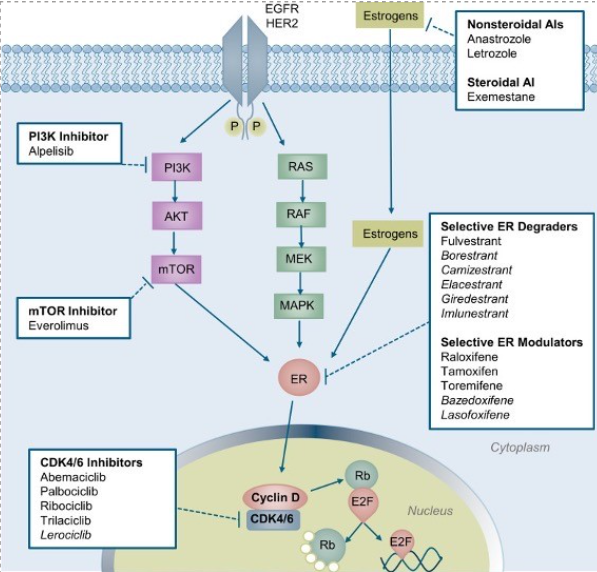
Image: from Ray-Coquard et al 2023
Figure 1 Combining endocrine and targeted therapies to overcome resistance. Resistance to endocrine therapies is common in hormone-driven cancers. Current strategies to overcome this resistance are focused on inhibiting upstream signaling pathways and CDK4/6. Approved therapies, and those currently in clinical development (italicized), are depicted with mechanisms of action that include targeting estrogens, estrogen receptor (ER), growth signaling pathways, and CDK4/6.
Bibliography
1. Gaillard S, Sill M, Klein J, et al. GOG3069: Phase 2 study of alpelisib and fulvestrant for PIK3CA-mutated estrogen receptor (ER)-positive endometrioid endometrial cancers. Journal of Clinical Oncology. 2024;42(16_suppl):TPS5639-TPS5639. doi:10.1200/JCO.2024.42.16_SUPPL.TPS5639
2. Gershenson DM, Bodurka DC, Coleman RL, Lu KH, Malpica A, Sun CC. JOURNAL OF CLINICAL ONCOLOGY Hormonal Maintenance Therapy for Women With Low-Grade Serous Cancer of the Ovary or Peritoneum. J Clin Oncol. 2017;35:1103-1111. doi:10.1200/JCO.2016.71.0632
3. Ray-Coquard I, Monk BJ, Lorusso D, et al. The promise of combining CDK4/6 inhibition with hormonal therapy in the first-line treatment setting for metastatic or recurrent endometrial adenocarcinoma. International Journal of Gynecological Cancer. 2023;33(12):1943. doi:10.1136/IJGC-2023-004739
4. Turner NC, Oliveira M, Howell SJ, et al. Capivasertib in Hormone Receptor–Positive Advanced Breast Cancer. New England Journal of Medicine. 2023;388(22):2058-2070. doi:10.1056/NEJMOA2214131
5. Green AK, Zhou Q, Iasonos A, et al. A Phase II Study of Fulvestrant plus Abemaciclib in Hormone Receptor-Positive Advanced or Recurrent Endometrial Cancer. Clin Cancer Res. 2025;31(11):2088-2096. doi:10.1158/1078-0432.CCR-24-1999
6. Slomovitz BM, Filiaci VL, Coleman RL, et al. GOG 3007, a randomized phase II (RP2) trial of everolimus and letrozole (EL) or hormonal therapy (medroxyprogesterone acetate/tamoxifen, PT) in women with advanced, persistent or recurrent endometrial carcinoma (EC): A GOG Foundation study. Gynecol Oncol. 2018;149:2. doi:10.1016/j.ygyno.2018.04.012
7. Slomovitz B, Deng W, Killion J, et al. GOG 3026 A phase II trial of letrozole + ribociclib in women with recurrent low-grade serous carcinoma of the ovary, fallopian tube or peritoneum: A GOG foundation study (001). Gynecol Oncol. 2023;176:S2. doi:10.1016/j.ygyno.2023.06.466
8. Yonemori K, Boni V, Min KG, et al. Imlunestrant, an oral selective estrogen receptor degrader, as monotherapy and combined with abemaciclib, in recurrent/advanced ER-positive endometrioid endometrial cancer: Results from the phase 1a/1b EMBER study. Gynecol Oncol. 2024;191:172-181. doi:10.1016/j.ygyno.2024.10.006
9. Study Details | NCT07209449 | A Study of Elacestrant Alone or in Combination With Abemaciclib in People With Endometrial Cancer | ClinicalTrials.gov. Accessed October 10, 2026. https://clinicaltrials.gov/study/NCT07209449
10. FDA approves elacestrant for ER-positive, HER2-negative, ESR1-mutated advanced or metastatic breast cancer | FDA. Accessed October 10, 2026. https://www.fda.gov/drugs/resources-information-approved-drugs/fda-approves-elacestrant-er-positive-her2-negative-esr1-mutated-advanced-or-metastatic-breast-cancer
11. Konstantinopoulos PA, Lee EK, Xiong N, et al. A Phase II, Two-Stage Study of Letrozole and Abemaciclib in Estrogen Receptor-Positive Recurrent Endometrial Cancer. J Clin Oncol. 2022;41:599-608. doi:10.1200/JCO.22
12. Pedroza DA, Subramani R, Lakshmanaswamy R. Classical and Non-Classical Progesterone Signaling in Breast Cancers. Cancers 2020, Vol 12, Page 2440. 2020;12(9):2440. doi:10.3390/CANCERS12092440
13. Yang S, Thiel KW, Leslie KK. Progesterone: the ultimate endometrial tumor suppressor. Trends Endocrinol Metab. 2011;22(4):145. doi:10.1016/J.TEM.2011.01.005
14. Mirza MR, Bjørge L, Marmé F, et al. Palbociclib plus letrozole in estrogen receptor-positive advanced/recurrent endometrial cancer: Double-blind placebo-controlled randomized phase II ENGOT-EN3/PALEO trial. Gynecol Oncol. 2025;192:128-136. doi:10.1016/j.ygyno.2024.12.003
15. Fiorica J V., Brunetto VL, Hanjani P, Lentz SS, Mannel R, Andersen W. Phase II trial of alternating courses of megestrol acetate and tamoxifen in advanced endometrial carcinoma: A Gynecologic Oncology Group study. Gynecol Oncol. 2004;92(1):10-14. doi:10.1016/j.ygyno.2003.11.008